Have you ever wondered why your customer in Jeddah, Cairo, or Doha might feel that your WhatsApp bot doesn't fully understand them, even if they speak Arabic? The answer lies in the vast diversity of Arabic dialects, a significant challenge for businesses aiming to deliver a seamless and personalized customer experience. In 2026, it's no longer enough for a bot to speak only Modern Standard Arabic (MSA); understanding local dialects has become an urgent necessity. Building an Arabic dialect WhatsApp bot is not just a luxury, but a strategic investment to deepen communication and build customer loyalty in the Middle East and North Africa (MENA) region.
The Big Challenge: Diverse Arabic Dialects and Their Impact on Business Communication
Arabic is one of the richest and most widely spoken languages globally, yet it features a unique dialectal diversity that complicates automated communication. From the Arabian Gulf to the Maghreb, words, structures, and even pronunciation vary significantly. This diversity creates a gap between businesses using traditional chatbots, which often rely on Modern Standard Arabic (MSA) or a specific dialect, and customer expectations of speaking in their native dialect. When a customer interacts with a bot that doesn't understand their dialect, they may feel frustrated, leading to a negative experience and loss of trust, which adversely affects conversion rates and sales.
In today's competitive market, merely having a WhatsApp support channel is no longer sufficient. Customers expect the bot to understand them clearly and respond accurately to their needs, just as they would from a human customer service representative. Failing to meet this expectation can lead to customer churn towards competitors who invest in more advanced and personalized solutions. This is why investing in an Arabic dialect WhatsApp bot has become an urgent necessity for businesses targeting multiple markets in the region.
Why Modern Standard Arabic (MSA) Alone Isn't Enough for an Excellent User Experience?
While Modern Standard Arabic (MSA) forms the foundation of written and formal communication, its use in daily conversations is highly limited. People speak and interact using their local dialects, which carry not only words but also cultural nuances and colloquial expressions that lend a personal touch to communication. When a customer receives an automated message in MSA, they might perceive it as dry and impersonal, reducing the likelihood of positive interaction with the bot.
Dialect understanding in a bot goes beyond mere literal translation of words. It's about comprehending cultural context, intentions, and even local humor. When a bot speaks in the customer's dialect, it builds a bridge of trust and familiarity, making the customer feel truly heard and understood. This enhancement in user experience not only boosts satisfaction but also extends to increased engagement, improved response rates for marketing campaigns, and reduced need for human intervention, saving businesses valuable time and resources.
How Can AI Understand Arabic Dialects in WhatsApp Bots?
Artificial Intelligence (AI), specifically advanced Natural Language Processing (NLP), is the optimal solution for the Arabic dialect challenge. These technologies rely on machine learning algorithms to train bots to understand and analyze vast amounts of textual and voice data across different dialects. Instead of merely searching for keywords, an AI WhatsApp bot for 2026 can comprehend the underlying intentions behind messages, even if they contain colloquialisms or local terms.
The process of training Arabic AI for WhatsApp involves several stages: First, collecting massive databases of spoken texts in various dialects (Egyptian, Saudi, Emirati, Kuwaiti, Qatari, Bahraini, and others). Second, teaching Language Models these dialects through deep learning techniques. Third, continuously refining these models through feedback from real interactions. The larger the data volume and training, the more accurate the bot becomes at understanding dialects and responding appropriately, allowing for the creation of a smart and effective Arabic dialect WhatsApp bot.
Platforms like LetsBot utilize the latest innovations in AI to enable businesses to train their WhatsApp bots to understand specific dialects. This not only includes texts but can also extend to understanding voice messages, opening new horizons for voice interaction with customers. The ability to adapt to dialectal differences positions businesses at the forefront of competition and ensures an unforgettable user experience.
Practical Steps to Build a WhatsApp Bot That Understands Customer Dialects
To turn the idea of an Arabic dialect WhatsApp bot into reality, meticulous planning and execution are required. Here are practical steps businesses can follow to ensure the success of this project:
- Identify Target Dialects: Start by pinpointing the most common dialects among your customer base. Are they from Saudi Arabia, Egypt, UAE, or a mix of several countries? Focusing on the most important dialects first ensures the best return on investment.
- Gather Dialectal Data: This step is crucial. Collect real-world examples of conversations in various dialects. This data can come from previous chat logs, surveys, or even by engaging native speakers to help create conversation scenarios.
- Choose an Advanced WhatsApp Bot Platform: Select a platform that supports advanced AI and Natural Language Processing, allowing you to train the bot on your specific data. A platform like LetsBot, an official Meta Business Partner, offers these capabilities with high flexibility.
- Train and Customize the Bot: Use the collected data to train the bot's AI models. Focus on speech patterns, common terms, and the phrasing of questions and requests in each dialect. The more comprehensive the training, the higher the accuracy of understanding.
- Continuous Testing and Iteration: After initial training, rigorously test the bot with native speakers of each dialect. Gather feedback, analyze errors, and then repeat the training process to improve performance. AI is constantly evolving, and so should your Arabic dialect WhatsApp bot.
- Integrate the Bot with Other Business Systems: To ensure maximum effectiveness, integrate your WhatsApp bot with Customer Relationship Management (CRM) systems, e-commerce platforms (such as Salla, Zid, and WooCommerce), and payment systems (Stripe and PayTabs) to provide a comprehensive experience.
LetsBot: Your Partner for a WhatsApp Bot That Speaks Your Customers' Dialects
At LetsBot, we fully recognize the importance of effective and personalized communication in the Middle East and North Africa (MENA) region. That's why we designed our platform to enable businesses to build sophisticated and intelligent Arabic dialect WhatsApp bots. As an official Meta Business Partner, we provide you with access to the official WhatsApp Business API, along with a wide range of tools and features that support dialect understanding and personalized interactions.
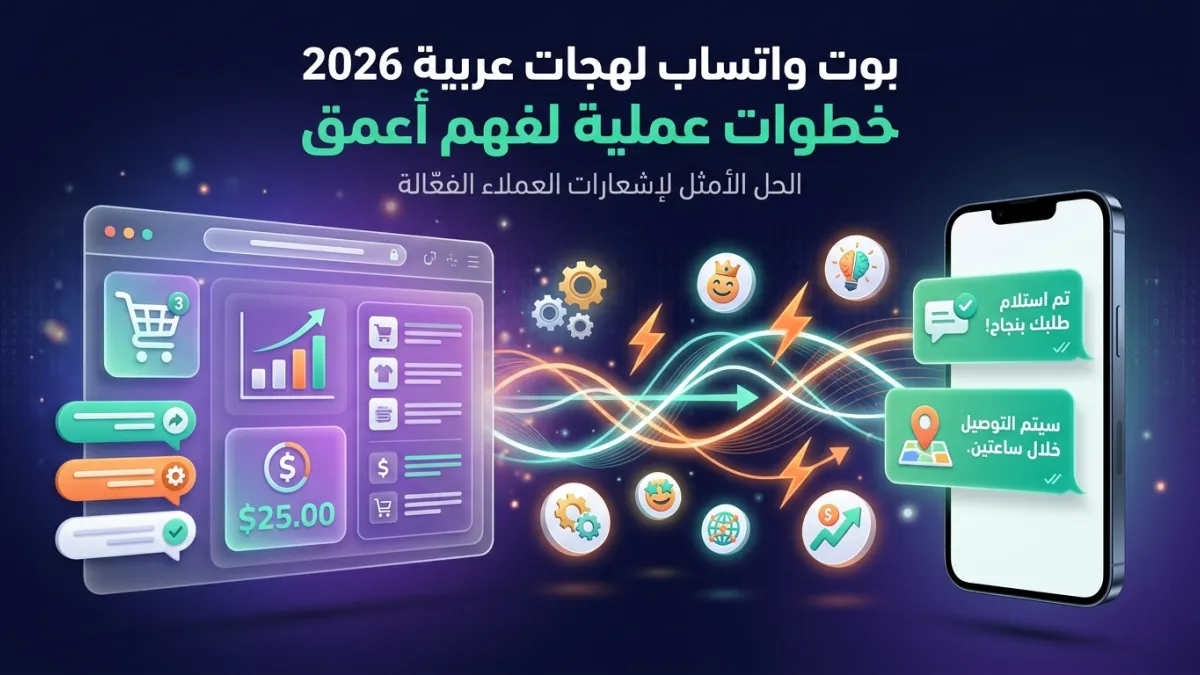
Through LetsBot's comprehensive platform, you can leverage a customizable AI chatbot, allowing you to train the bot on specific dialects and colloquial phrases unique to your customer region. Whether you want to automate responses to frequently asked questions, recover abandoned carts, or send order status notifications, our bots are designed to speak your customer's language, significantly boosting loyalty and enhancing the user experience. We also offer 24/7 Arabic customer support to assist you every step of the way.
In addition to dialect understanding, LetsBot offers integrated solutions including: bulk messaging, multi-agent live chat, seamless integrations with e-commerce platforms like Salla, Zid, and WooCommerce, and payment support via Stripe and PayTabs. We also adhere to regional regulatory compliance (CITC, TDRA, NTRA, CITRA, CRA, TRA) to ensure a secure and reliable environment for your operations. With LetsBot, you don't just get a bot; you gain a strategic partner that helps you speak to the heart and soul of your customers.