
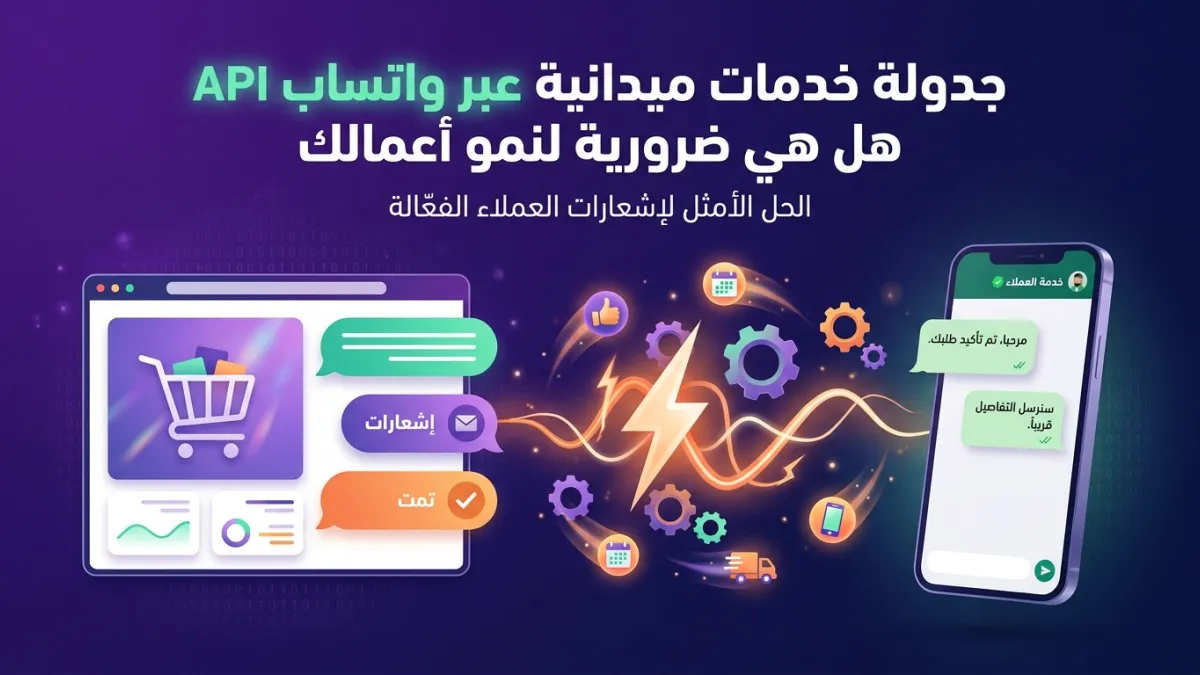
Imagine a scenario where your customer contacts your technical support service, only to discover that their AC maintenance appointment has been canceled or postponed without their knowledge, or that the technician didn't arrive on time due to a coordination error. These frustrating scenes are not uncommon in the business world that relies on field service teams to deliver services. Efficient field service scheduling is the lifeblood of many businesses, from maintenance and installation to logistics and home healthcare. However, traditional methods are often prone to errors, time-consuming, and lead to customer frustration.
In today's fast-paced world, phone calls or emails are no longer enough. Customers expect speed, transparency, and convenience. This is where WhatsApp API emerges as a revolutionary solution. Could field service scheduling via WhatsApp API be the key to growing your business and outperforming competitors in the Saudi and Gulf markets? Let's explore how this technology can transform your challenges into opportunities.
Traditional Challenges in Managing Field Service Teams and Scheduling Services
Companies relying on WhatsApp API services have long faced significant challenges in coordinating appointments and tracking field teams. These challenges range from simple human errors to major logistical complexities that directly impact the company's reputation and customer satisfaction. Manual scheduling processes, which depend on phone calls or spreadsheets, often lead to conflicting appointments, unjustified delays, and misunderstandings between customers and service providers.
Furthermore, the lack of instant and reliable communication channels makes it difficult for businesses to inform customers about important updates, such as a technician's delay or an appointment change. This lack of transparency creates frustration and distrust, prompting customers to seek alternatives. Moreover, the inability to track the performance of field service teams in real-time limits management's ability to improve efficiency and identify weaknesses, negatively impacting productivity and profitability.
How WhatsApp API Changes the Game in Field Service Scheduling?
With the immense popularity of WhatsApp as a primary communication tool in the Middle East and North Africa region, the official WhatsApp Business API has become an indispensable tool for businesses seeking to enhance customer interaction and streamline their operations. When it comes to field service scheduling, WhatsApp API offers a comprehensive solution that goes beyond merely sending messages, becoming an integrated system for managing appointments and communicating with customers and field teams with unparalleled efficiency.
By integrating WhatsApp API, businesses can fully automate the booking process, from receiving a service request to confirming the appointment and sending automated reminders. This not only saves time and effort for support staff but also ensures that the customer receives all necessary information promptly and through their preferred channel. WhatsApp API also enables instant updates on service status, such as "Technician on the way" or "Service completed," which enhances transparency and reduces customer anxiety.
Key Advantages of Using WhatsApp API for Field Service Scheduling
Implementing WhatsApp API for field service scheduling brings a wide range of benefits that positively impact both customers and the company's internal operations. These advantages are not limited to improving customer experience but also extend to enhancing operational efficiency and cost savings, making it a wise investment for any business that relies on field teams.
- Enhanced Customer Experience: Customers can now easily book services or modify appointments via WhatsApp, a platform they use daily. They receive instant confirmations and automated reminders, reducing missed appointments.
- Increased Operational Efficiency: Automation reduces the need for human intervention in repetitive scheduling tasks, freeing up staff to focus on more critical duties. Real-time tracking of field teams also allows for optimized routes and efficient task distribution.
- Cost Savings: By reducing inbound and outbound phone calls, minimizing human errors, and optimizing resource utilization, businesses can achieve significant savings. Fewer missed appointments also mean less waste of time and resources for field service teams.
- Improved Communication: WhatsApp provides a direct and effective communication channel between the company and the customer, as well as between management and field teams. Important notifications, such as a technician's delay or weather updates, can be sent instantly.
- Scalability: Designed to support the rapid growth of your business, WhatsApp API can handle a large volume of messages and scheduling without significantly increasing your workforce.
These combined benefits position businesses more strongly for competition, enabling them to offer an unparalleled customer service experience while significantly improving operational efficiency.
LetsBot Features for Integrated Field Service Scheduling Support
LetsBot, as an official Meta Business Partner, understands the unique needs of businesses in the Middle East and North Africa region, especially those relying on field service teams. Our platform is specifically designed to enable you to maximize the benefits of WhatsApp API for field service scheduling, delivering a seamless and efficient experience for both your customers and employees. Here's how the complete LetsBot platform supports this process:
- AI WhatsApp Bot with Custom Training: Automate initial appointment booking and respond to frequently asked questions 24/7. The bot can be trained to collect necessary information from the customer, confirm service availability, and even suggest the best available times for booking.
- Multi-Agent Live Chat Inbox: Don't let any inquiry go unanswered. Multiple agents from your support or scheduling team can manage WhatsApp conversations in a single inbox, ensuring quick responses to complex inquiries or those requiring human intervention.
- Bulk Messaging Campaigns: Send mass updates to your customers about schedule changes, special service offers, or general announcements. This feature is ideal for managing communication with a large customer base.
- E-commerce Integrations (Salla, Zid, WooCommerce, Magento): If your services are linked to products sold through your online store, LetsBot's integrations allow you to directly link order data with service scheduling, making it easy for customers to request installation or maintenance services for products they've purchased.
- CRM Integrations (HubSpot, Pipedrive): Connect your customer data, service history, and scheduling systems to create a unified customer view. This ensures your field service team is equipped with all necessary information before reaching the customer.
- Order Status Notifications: Send automated notifications to customers at every stage of the service, from booking confirmation to job completion. For example, a customer can receive a "Technician is on their way" message with a tracking link if desired, or "Service successfully completed."
With LetsBot, you don't just get a messaging tool; you get an integrated ecosystem that supports highly efficient field service scheduling, ensuring customer satisfaction and improving your operational performance.
Steps to Implement Field Service Scheduling via WhatsApp API with LetsBot
The journey to transform your field service scheduling using WhatsApp API begins with clear and defined steps. With LetsBot, this process becomes easy and straightforward, ensuring a smooth transition towards automation and efficiency. Here are the essential steps you need to implement a comprehensive field service scheduling system:
- Obtain Official WhatsApp Business API: The first and most crucial step is to gain access to the WhatsApp Business API. As an official Meta Business Partner, LetsBot fully facilitates this process, from registration to technical setup, ensuring compliance with all Meta requirements.
- Define Your Scheduling Workflow: Before starting automation, you must define how you want the scheduling process to work. What information do you need from the customer? How will appointments be confirmed? How will field service teams be informed? And what messages will be sent at each stage?
- Set Up Bot and Interactive Messages: Use the LetsBot platform to create a smart WhatsApp bot that can handle initial scheduling requests. Design interactive and clear messages that guide the customer step-by-step through the booking process, with options to choose from available services and suitable times.
- Integrate Other Systems (Optional but Recommended): To maximize benefits, integrate WhatsApp API with your existing scheduling systems, CRM (such as HubSpot or Pipedrive) for customer relationship management, or even e-commerce platforms (like Salla or Zid). This integration ensures seamless data flow and gives you a comprehensive overview.
- Train Field Service Team and Launch Service: Train your field service team on how to use the new system and how to handle updates and notifications via WhatsApp. Afterward, you can gradually launch the service and gather feedback for performance improvement.
- Continuous Analysis and Improvement: Use the analytics tools available on the LetsBot platform to track the performance of your scheduling system. Monitor response rates, customer satisfaction, and the efficiency of field service teams, and make necessary adjustments to continuously improve the process. You can use our WhatsApp ROI calculator to evaluate your return on investment.
By following these steps, you will be able to build a robust and efficient field service scheduling system that provides you with a true competitive advantage.