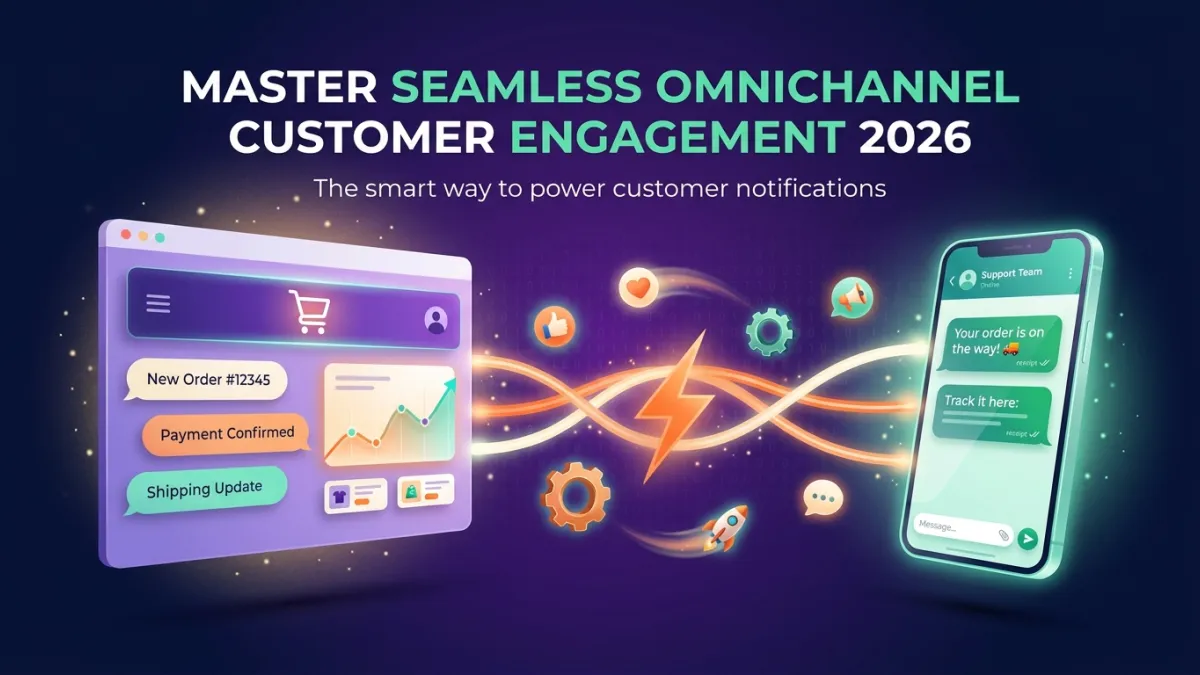
Imagine a potential customer browsing your e-commerce store, adding a product to their cart, then leaving without completing the purchase. Minutes later, they receive a personalized WhatsApp message reminding them of the product and offering a small discount. Subsequently, an email notification confirms the discount, and the next day, they receive a brief automated call offering assistance if they encounter any issues. This is not a distant dream; it's the essence of seamless omnichannel communication that businesses and customers expect in 2026 and beyond.
In a world of increasing distractions and numerous touchpoints, merely being present on multiple channels is no longer enough. The real challenge lies in integrating these channels to form a unified, coherent experience, where the customer feels understood and communicated with in their language and on their preferred channel, without having to repeat information or start the conversation from scratch every time. How can organizations in the Middle East and North Africa (MENA) region achieve this level of connection and transform it into a true competitive advantage?
Why Omnichannel Communication Has Become Indispensable
Gone are the days when customers were content communicating with businesses through a single channel. Today, the modern customer expects a seamless and integrated experience across every touchpoint, whether it's a WhatsApp message, email, phone call, or even social media. If they start a conversation on WhatsApp, they expect a customer service representative to be able to follow up via email without asking them to repeat details. This shift is not merely a luxury; it's a response to a fundamental change in consumer behavior.
Statistics indicate that companies adopting a strong omnichannel communication strategy achieve customer retention rates up to 89% higher compared to those that don't. This is because customers feel valued and understood when businesses can meet their needs wherever they are. Failure to provide an integrated experience leads to customer frustration, decreased loyalty, and ultimately, revenue loss.
Furthermore, an omnichannel communication strategy enables businesses to gather deeper insights into customer behavior and preferences. By tracking the customer journey across various channels, companies can tailor their offers and messages more effectively, increasing conversion rates and enhancing customer satisfaction. This comprehensive understanding is what distinguishes market-leading companies.
Key Challenges in Building an Omnichannel Communication Strategy
Despite the clear benefits, building an effective omnichannel communication strategy is not easy. Businesses face numerous challenges that require careful planning and investment in the right technology. One of the biggest challenges is data fragmentation; customer information is often stored in separate systems for each channel (e.g., a CRM for email, a separate platform for WhatsApp, and another for SMS), making it difficult to gain a unified and comprehensive customer view.
Another challenge is ensuring consistency in messaging and tone of voice across all channels. The customer should feel that they are interacting with the same brand, regardless of the channel they choose. This requires sophisticated message orchestration, where content and timing are precisely coordinated to avoid sending conflicting or repetitive messages. Integrating different systems can also be complex and costly, especially for companies relying on legacy systems.
At LetsBot, we understand these challenges well. That's why we designed the complete LetsBot platform to be a comprehensive solution that combines the power of WhatsApp with advanced integration features, helping businesses overcome these obstacles and achieve seamless, effective communication with their customers. We provide the necessary tools to unify customer data and simplify channel management, paving the way for an exceptional customer experience.
Pillars of the Solution: How to Build an Effective Omnichannel Communication System?
To build an effective omnichannel communication system, focus on three fundamental pillars: Smart Integration, Advanced Automation, and Deep Personalization. First, Smart Integration means connecting all communication channels, Customer Relationship Management (CRM) systems, and e-commerce platforms (such as Salla, Zid, and WooCommerce) into a unified system. This ensures that all customer data is available in one place, giving your team a 360-degree view of each customer and allowing seamless tracking of their journey across channels like WhatsApp, Email, and SMS.
Second, Advanced Automation is key to efficiency. This is where AI-powered WhatsApp bots come into play. These bots can handle repetitive inquiries, provide 24/7 support, and even guide customers to the right products or services, freeing up your support team to focus on more complex issues. The LetsBot platform offers an AI WhatsApp Bot 2026 Guide that illustrates how to maximize the benefits of these technologies to enhance the customer experience.
Third, Deep Personalization is what transforms an ordinary interaction into a memorable experience. By analyzing customer data, you can send highly personalized messages based on their past behavior, purchases, and even their interactions with your brand across different channels. For example, LetsBot can automate abandoned cart recovery messages, order status notifications, and even two-factor authentication (OTP) messages via WhatsApp, ensuring that every message is relevant and personally targeted.
The Role of WhatsApp as the Backbone of Omnichannel Communication in the MENA Region
In the Middle East and North Africa (MENA) region, the pivotal role of WhatsApp cannot be overlooked. With millions of daily active users, WhatsApp has become the preferred channel for both personal and business communication. This makes it a backbone for any successful omnichannel communication strategy in the region. By utilizing the official WhatsApp Business API, businesses can connect with their customers in a personal and direct manner, leveraging powerful features that go beyond mere text messages.
LetsBot, as an official Meta Business Partner, provides businesses with full access to the WhatsApp Business API, opening the door to a wide range of solutions: from targeted bulk messaging campaigns to multi-agent live chat that allows several employees to handle customer inquiries in a single inbox. We also support integration with payment gateways like Stripe and PayTabs, and offer 24/7 Arabic customer support, with our commitment to complying with regional regulations such as CITC, TDRA, NTRA, and others.
Seamlessly integrating WhatsApp into an omnichannel communication strategy allows businesses to deliver an unparalleled customer experience, from the first moment of interest through post-purchase. Whether it's sending instant notifications, providing technical support, or even facilitating direct sales, WhatsApp offers an effective channel with high engagement rates, fostering loyalty and driving business growth.