
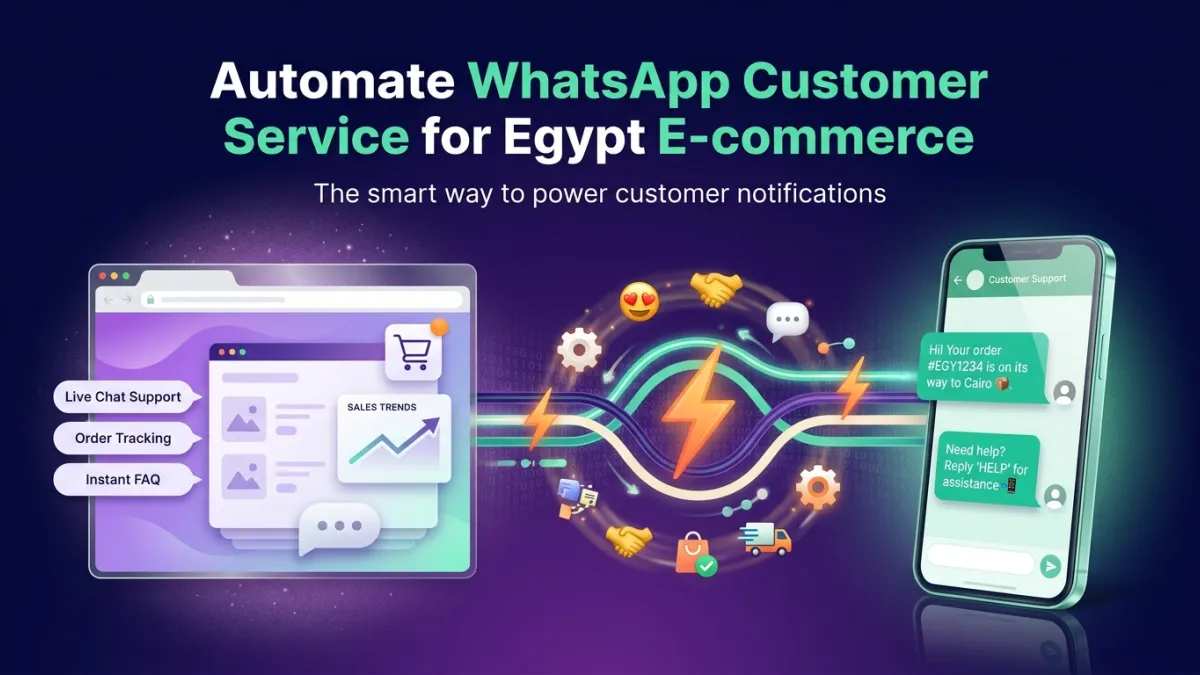
Imagine a scenario where a potential customer visits your e-commerce store in Egypt, adds products to their cart, then suddenly leaves. How many of these customers can you manually recover? And how much time and effort would it take to respond to hundreds of daily inquiries about order status, product details, or return policies? In Egypt's fast-paced e-commerce landscape, WhatsApp customer service is no longer just an added feature; it's an essential necessity to convert visitors into loyal buyers. But how can an e-commerce store provide excellent customer service on WhatsApp without drowning in a sea of manual messages? The answer lies in smart automation, which we will explore in this comprehensive guide.
Why WhatsApp is the Lifeline for Customer Service in Egyptian E-commerce?
Egypt, being one of the largest e-commerce markets in the Middle East and North Africa (MENA) region, relies heavily on WhatsApp as a primary communication tool. Millions of Egyptians use WhatsApp daily to connect with friends and family, and with the increasing spread of online shopping, they expect the same level of ease and speed when interacting with e-commerce stores. This makes WhatsApp the ideal platform for delivering instant and personalized customer service.
However, using the regular WhatsApp Business App is not enough for large or rapidly growing stores. This is where the official WhatsApp Business API comes in, opening up new horizons for automation and scalability. Through it, e-commerce stores in Egypt can connect their systems to the WhatsApp API, enabling bulk messaging, multi-agent chat management, and most importantly, 24/7 automated responses to common inquiries.
Investing in an automation-driven WhatsApp marketing guide means your store can remain available to its customers even after business hours, providing a seamless shopping experience that reduces abandoned cart rates and increases customer satisfaction, ultimately boosting sales.
Challenges of Manual WhatsApp Customer Service in E-commerce
Without automation, e-commerce stores face significant challenges when trying to provide effective customer service via WhatsApp:
- Overwhelm from Message Volume: As a store grows, the number of incoming messages increases dramatically, making it difficult for a human support team to keep up.
- Slow Response Times: Customers expect instant responses. Delays in replying lead to customer frustration and may prompt them to seek alternatives.
- Repetitive Tasks: Many inquiries are repetitive (e.g., "Where is my order?", "How much does product X cost?"). Responding to them manually wastes valuable time that could be used for more complex tasks.
- Human Errors: Pressure and workload can lead to errors in responses or missed messages, negatively impacting the customer experience.
- Lack of 24/7 Availability: A human support team cannot operate 24/7, meaning customers outside business hours may not find anyone to answer their inquiries.
These challenges not only affect customer satisfaction but also increase operational costs and reduce operational efficiency. Therefore, transitioning to automation is no longer an option but a strategic necessity for e-commerce stores aspiring to grow in the Egyptian market.
Steps to Automate WhatsApp Customer Service for Your E-commerce Store in Egypt with LetsBot
To implement effective WhatsApp customer service automation, a structured approach is essential. The LetsBot platform provides the necessary tools to achieve this seamlessly:
1. Connecting Your E-commerce Store to the WhatsApp Business API
The first and most crucial step is to obtain the official WhatsApp Business API. LetsBot, as a Meta Business Partner, simplifies this process for you. After obtaining the API, you can directly connect your store. LetsBot supports ready-made integrations with the most popular e-commerce platforms in Egypt and the region, such as Salla, Zid, and WooCommerce, in addition to Magento. This connection allows for data flow between your store and WhatsApp, which is the foundation of automation.
2. Setting Up a Smart WhatsApp Bot for Automated Responses
With LetsBot, you can build a smart LetsBot WhatsApp bot that can be specifically trained for your store. This bot can handle a wide range of common inquiries:
- Responding to Frequently Asked Questions (FAQs): Such as business hours, payment methods, return policies, and product details.
- Order Tracking: Customers can enter their order number to get an instant status update without human intervention.
- Abandoned Cart Recovery: The bot sends automated reminder messages to customers who added products to their cart but did not complete the purchase, with a direct link to finalize it.
- Order Status Notifications: Sending automated updates to customers when their order status changes (e.g., shipped, delivered).
- Offering Personalized Promotions: Based on purchase history or browsed products, the bot can suggest relevant products and offers.
You can refer to the AI WhatsApp Bot Guide 2026 to deepen your understanding of this technology's capabilities.
3. Activating Multi-Agent Live Chat
Despite the power of automation, there's always a need for human intervention in complex cases or to provide a personal touch. LetsBot offers Live Chat with a Multi-Agent Inbox, allowing your customer service team to handle conversations that the bot cannot resolve efficiently. The bot can seamlessly transfer conversations to a human agent when needed, providing a complete conversation history to ensure continuous support. This ensures no customer is left unattended and provides the best possible experience.
4. Leveraging Bulk Messaging and Marketing Campaigns
In addition to customer service, WhatsApp can be utilized for marketing purposes. LetsBot enables you to launch targeted bulk messaging campaigns to inform customers about new offers, discounts, or products back in stock. Customers can be segmented based on their purchasing behavior or interests to ensure the right message reaches the right person, increasing the effectiveness of marketing campaigns and improving your WhatsApp ROI calculator.
5. Integrating Payment Solutions and Customer Relationship Management (CRM) Systems
To achieve maximum automation and efficiency, LetsBot supports integrations with payment gateways like Stripe and PayTabs, facilitating the sending of multi-currency invoices (including Egyptian Pound EGP) and payment confirmation via WhatsApp. The platform can also be linked to CRM systems like HubSpot and Pipedrive for more comprehensive customer relationship and sales management, providing a 360-degree view of each customer.
Benefits of Automating WhatsApp Customer Service for Your Store in Egypt
Transitioning to automation in WhatsApp customer service offers a wide range of tangible benefits for e-commerce stores in Egypt:
- Enhanced Customer Satisfaction: Instant responses and 24/7 support reduce customer frustration and increase their happiness.
- Increased Sales: Abandoned cart recovery, personalized recommendations, and effective communication convert more visitors into buyers.
- Cost Savings: Reducing the need for a large human support team and minimizing repetitive manual tasks.
- Improved Team Efficiency: The support team can focus on more complex issues requiring human intervention, instead of answering repetitive questions.
- Better User Experience: A seamless purchasing process and instant support enhance brand loyalty.
- Compliance with Local Standards: LetsBot ensures compliance with regional regulations like NTRA in Egypt, providing peace of mind for your business.
- Local Support: Providing 24/7 customer support in Arabic, which is vital for the Egyptian market.
By using the complete LetsBot platform, you can achieve all these benefits and more, positioning your e-commerce store at the forefront of competition in the Egyptian market.
Advanced Integrations to Support Egyptian E-commerce
Automation isn't limited to automated responses only. With LetsBot, you can significantly expand your service offerings:
- Order Confirmations and OTP: WhatsApp can be used to send order confirmations and One-Time Passwords (OTP) to enhance security and user experience.
- ChatGPT Integration: Integrating the ChatGPT app for WhatsApp allows your chatbot to have a deeper understanding of natural language and provide more accurate and intelligent answers.
- Inventory Management: WhatsApp can be linked to inventory management systems to send automated alerts to customers when an out-of-stock product becomes available, or to help your team monitor stock levels.
- Reviews and Ratings: After a purchase is completed, the bot can request product and service reviews via WhatsApp, making it easier to collect valuable customer feedback.
With these capabilities, WhatsApp customer service transforms from merely a support channel into a powerful tool for growth and expansion for your e-commerce store in Egypt.