
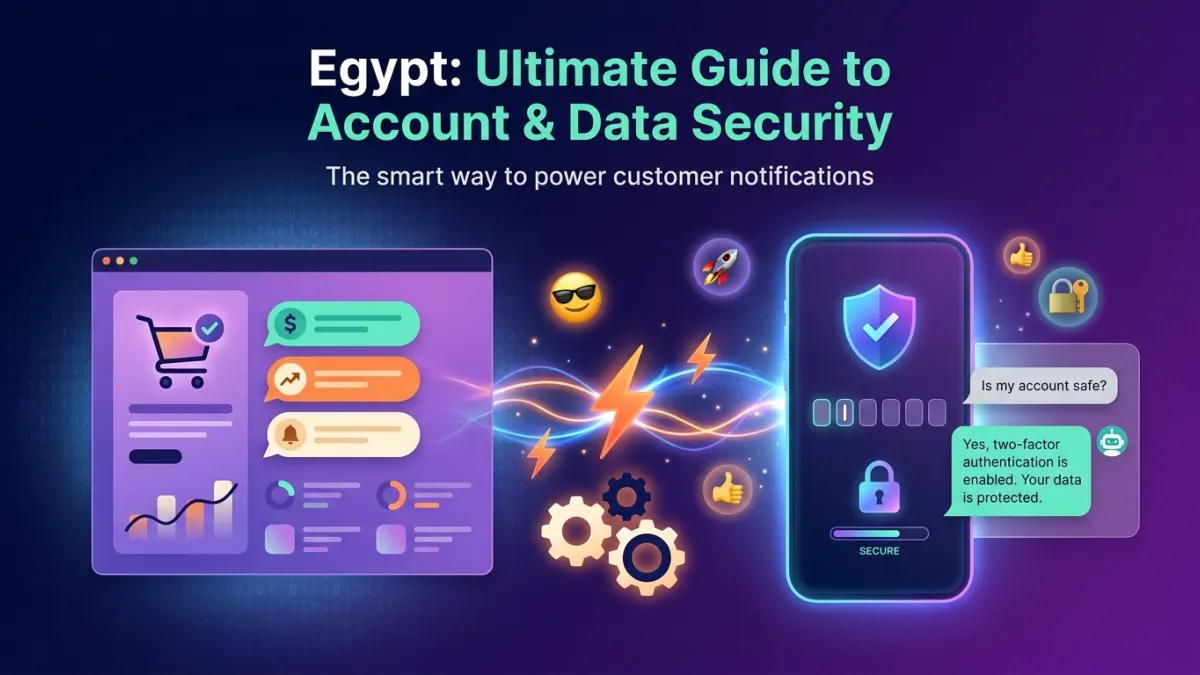
In today's digital business world, account security and data protection are no longer mere optional features; they have become an absolute necessity, especially in a vibrant market like Egypt. Imagine managing a thriving e-commerce store or a service company that heavily relies on communicating with customers via WhatsApp and other platforms, only to wake up and find that your sensitive customer data has been breached. This would not only lead to a loss of trust but also extend to hefty regulatory fines and damage to your brand's reputation that could take years to repair. This isn't a distant hypothetical scenario; with the increasing number of cyber attacks, Egyptian businesses must take proactive steps to ensure the safety of their information and their customers' data.
Growing Security Challenges for Businesses in Egypt
Egypt's digital landscape is experiencing tremendous growth, bringing with it promising business opportunities but also raising the level of security risks. Businesses, regardless of their size, are facing increasing threats such as phishing attacks, malware, and data breaches, which specifically target communication channels through which sensitive business messages are exchanged. These attacks aim not only to steal financial data but also personal customer information and transaction records, exposing businesses to significant legal and financial risks.
For companies that rely on messaging platforms like WhatsApp, Instagram, and Facebook Messenger to interact with customers, protecting these channels becomes vital. Every message exchanged, every service request, and every purchase made through these channels carries data that could be valuable to intruders. Therefore, choosing a secure platform to manage these communications is the first step towards building a robust protective shield that ensures account security and safeguards the company's reputation.
The Regulatory Framework for Data Protection in Egypt
The Egyptian government has recognized the importance of data protection in the digital age and issued Law No. 151 of 2020 concerning Personal Data Protection. This law imposes strict obligations on companies that collect, process, or store the personal data of Egyptian citizens. This includes the necessity of obtaining explicit consent, appointing a Data Protection Officer (DPO), and implementing appropriate security measures to protect this data from unauthorized access or breach.
The National Telecommunication Regulatory Authority (NTRA) in Egypt, along with other regional regulatory bodies such as CITC in Saudi Arabia and TDRA in the UAE, is responsible for overseeing the implementation of these regulations. Compliance with these laws is not just a formality; it reflects a company's commitment to protecting customer privacy, which is essential for building trust and loyalty in the Egyptian market. Companies that fail to comply may face huge financial penalties amounting to millions of Egyptian Pounds, in addition to irreparable damage to their reputation.
How LetsBot Ensures Account Security and Data Protection for Your Customers in Egypt?
At LetsBot, we understand that account security and data protection are the cornerstones of any successful business strategy, especially when dealing with sensitive communication channels like WhatsApp. As an official Meta Business Partner, we provide solutions built on the official WhatsApp Business API, ensuring the highest security and compliance standards set by Meta itself.
LetsBot's comprehensive platform is designed to provide a secure and integrated environment for managing all your customer communications, whether through WhatsApp, Instagram Direct Messages, Facebook Messenger, or Telegram. We recognize the unique challenges faced by businesses in Egypt and the region, and therefore, we are committed to providing solutions that not only meet business requirements but exceed them to ensure peace of mind regarding information security.
Our platform includes a suite of advanced account security features that ensure round-the-clock protection for your and your customers' data:
- Two-Factor Authentication (2FA): This feature requires an additional verification step when logging in, adding a strong layer of protection against unauthorized access. Even if someone manages to learn your password, they won't be able to log in without the second verification code.
- Auditable Activity Logs: All actions taken within your LetsBot account are recorded in a detailed activity log. This log allows you to track who made what changes and when, helping to detect any suspicious activity or tampering attempts.
- IP Address Restrictions: You can specify particular IP addresses from which your account is allowed to be accessed, preventing logins from unauthorized locations and significantly reducing the risk of breaches, without affecting incoming messages or integrations.
- Session Expiry Times: Automatic expiry times are set for active sessions, requiring re-login after a certain period of inactivity. This reduces the risk of leaving accounts open unattended.
- GDPR and Regional Regulations Compliance: LetsBot adheres to global data protection standards like GDPR, as well as regional regulations in Egypt (NTRA), Saudi Arabia (CITC), UAE (TDRA), Kuwait (CITRA), Qatar (CRA), and Bahrain (TRA), ensuring that your data is processed according to the highest legal and ethical standards.
- WhatsApp MCP Server: We offer a free MCP (Managed Cloud Provider) server with any API plan, specifically designed to meet Meta's high security requirements and ensure service continuity and data protection.
In addition, the integrations we provide with systems such as Salla, Zid, WooCommerce, Stripe, PayTabs, HubSpot, and Pipedrive are implemented according to strict security protocols to ensure secure and reliable data exchange. Furthermore, the use of artificial intelligence in our chatbots, whether through our drag-and-drop bot builder or integration with ChatGPT and Claude, is done while maintaining customer data privacy and confidentiality.
For more details on the security measures we take, you can visit our dedicated page for LetsBot Account Security.
Best Practices for Account Security for Egyptian E-commerce Businesses
While LetsBot provides a secure infrastructure, account security is a shared responsibility. Egyptian e-commerce businesses must adopt best practices to enhance the protection of their data and customer data. These practices not only complement technical solutions but also strengthen overall defenses against evolving cyber threats:
- Continuous Employee Training: Employees are the first line of defense. They should be regularly trained on how to identify phishing attacks, the importance of using strong and unique passwords, and how to handle sensitive data securely.
- Use Strong and Unique Passwords: A strong password policy should be enforced, including uppercase and lowercase letters, numbers, and symbols, and passwords should be changed regularly. Using a password manager can assist in this process.
- Implement the Principle of Least Privilege: Employees should be granted the minimum necessary permissions and access to data and systems required to perform their tasks only. This reduces the scope of potential damage in case an employee's account is compromised.
- Regular Security Reviews: Conduct regular security audits of systems and processes to identify potential vulnerabilities and address them before they can be exploited by attackers.
- Software and System Updates: Ensure that all software and systems, including operating systems and web applications, are updated with the latest security patches.
- Data Backups: Perform regular backups of important data and store them securely and encryptedly to ensure recovery in case of disaster or a cyber attack.
By combining LetsBot's secure platform with these practices, Egyptian businesses can build a robust strategy for data protection and account security, enhancing customer trust and supporting sustainable growth in the competitive digital market.